
A Free Expression Committee at MIT Demonstrates the Need to Make Its Work Permanent
When everyone up to the president is asking for your input, it's a sign your work should be institutionalized.

Last fall, MIT’s Committee on Academic Freedom and Campus Expression (CAFCE) concluded its work after nearly two years in operation. Its final report has recently been published, allowing the community to gain a greater appreciation of the work that went on behind the scenes.
Among the major takeaways: once CAFCE was impaneled, there was no shortage of issues on which its opinions were sought, including by MIT’s president, Sally Kornbluth. This is a good sign that the work of such a committee will always be needed, and it would behoove MIT to leave a permanent committee in its place.
First, a little background on how CAFCE came to be. First envisioned by President Kornbluth as a subcommittee of MIT’s standing Faculty Policy Committee, CAFCE was upgraded to a stand-alone ad hoc committee and charged with advising the university on implementing the bulk of the recommendations from the prior Ad Hoc Working Group on Free Expression (commonly referred to as FEWG). That prior working group crafted MIT’s Statement on Freedom of Expression and Academic Freedom, but also left behind several other yet-to-be-implemented recommendations in its final report.
Co-chairing the committee were professors Michael Sipser and Anette (Peko) Hosoi. This choice inspired confidence from the start; both professors had signed onto a statement calling for MIT to adopt a version of the Chicago Principles, and Sipser had previously served on FEWG when it drafted MIT’s new free expression statement. The co-chairs were generous with their time and solicited a wide range of input, including from MFSA, as they went about their work. They also kindly accepted our invitations to discuss the committee’s work at both our 2024 and 2025 conferences. Before delivering its final report, CAFCE met more than 50 times.
CAFCE’s original charge envisioned that, to some extent, the committee would be able to function as a kind of on-call service for the MIT community when speech controversies arose on campus. Even so, global events highlighted by the October 2023 attacks in Israel quickly defined its work. Rather than the more abstract work of crafting a road map for MIT to implement the prior working group’s recommendations, CAFCE found a lot of its time being devoted to triaging ongoing free speech controversies, sometimes as they played out on the front pages.
A handful of speech controversies and major policy questions form the spine of CAFCE’s final report, which includes the text of statements the committee issued in response to these matters. These include CAFCE’s notes on its deliberations over a new postering policy at MIT, which was instituted following a controversy in 2023 in which a student placed intentionally provocative and offensive posters around the campus. CAFCE also weighed in on a new demonstration policy that MIT instituted following the post-October 7 disruptions, and addressed a controversy involving a pro-Palestinian student publication called Written Revolution, whose distribution activities were suspended following the publication of an article supporting violent revolution.1
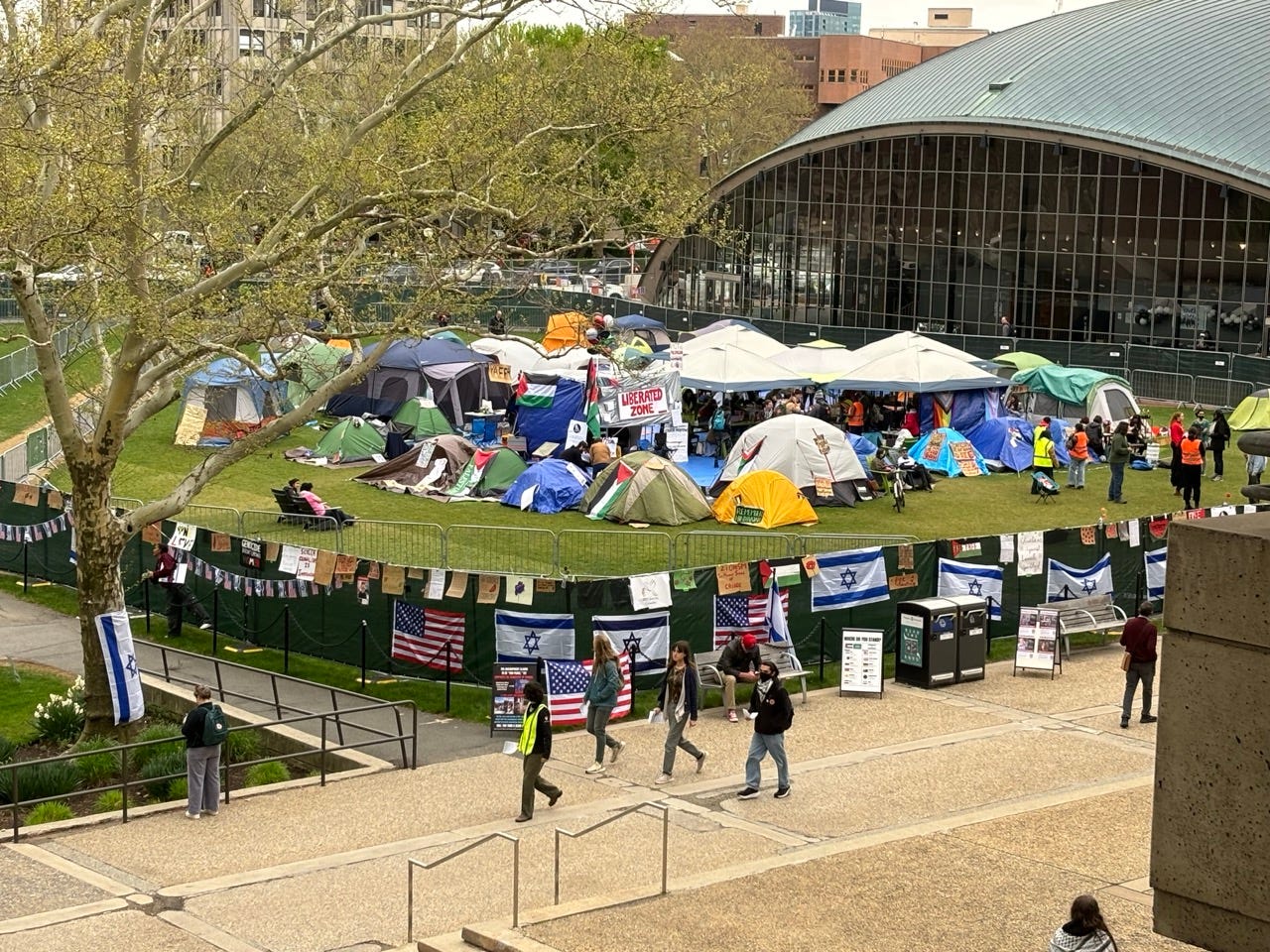
The most prominent controversy that occurred during CAFCE’s tenure, surely, was the unsanctioned encampment set up on MIT’s Kresge Oval for several weeks in spring 2024. I ran into Professor Sipser at least once during my many trips to observe the encampment, which became more volatile and more of a liability to the institution as it progressed, before President Kornbluth finally ordered its removal.
CAFCE was doing the same thing we were: taking in the scene as it developed in real time while trying to square its aims with the realities of MIT’s time, place, and manner regulations. We ultimately came to the same conclusion: that however well-intentioned the encampment was, it was inconsistent with MIT’s free speech regulations and violated the rights of other student organizations. As such, those participating in the encampment had to be prepared to accept sanctions for their participation.
These are all important services CAFCE has provided, but what stands out to this reader is the extent to which its informed opinion was sought at all levels of the institution. As CAFCE’s report notes:
CAFCE was originally charged with developing a roadmap for implementing the FEWG recommendations; however, given the [post-October 7 climate] context described above, President Kornbluth and the Office of the General Counsel requested that the committee review additional policies and provide guidance.
A section of the report on CAFCE’s advisory work further illuminated the “if you build it, they will come” effect of having a committee whose primary focus is free expression:
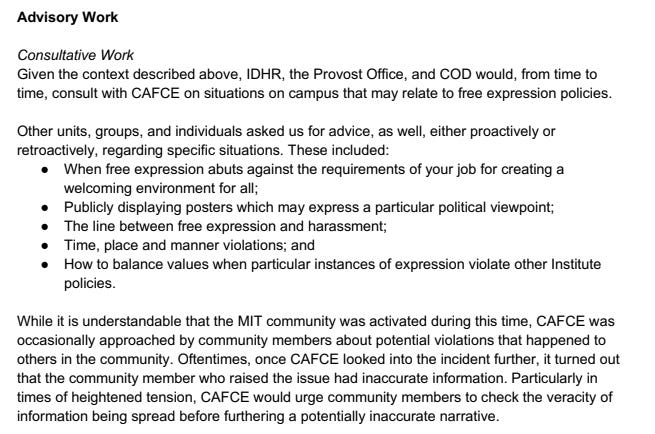
It’s little surprise, then, that CAFCE recommends that “[i]n the current moment, with free expression and academic freedom as contested topics within and outside MIT’s community, CAFCE believes it is prudent to formalize a faculty-led standing committee whose charge involves free expression and academic freedom.”
This makes sense for two reasons. One is the fact that, as CAFCE noted, part of its original mandate was left on the table as they found their input requested on various policy matters and felt compelled to respond to and articulate positions on real-time free speech controversies. Academic freedom issues, they note, were given relatively short shrift in deference to the many campus protest issues, and their work was diverted to the point that they weren’t able to complete the “roadmap” to implementing the prior committee’s recommendations originally envisioned by their mandate.
The other reason is that, as an official standing committee, they would be given a place at the table on matters of institutional free expression policy and programming. This is important, which is why it’s one of our highest-priority recommendations for free speech at MIT. Elevating CAFCE to the status of a permanent standing committee would, we argued, “ensure faculty are central to discussions and debates on free expression, in keeping with their traditional role as stewards of free expression and academic freedom.”
We hope this outcome will come to pass. CAFCE was a well-constituted body that took its mandate seriously and provided a genuine service to MIT during a fraught time. MIT should now ensure that that service can continue on a permanent basis.
MFSA weighed in on the Written Revolution controversy as well, finding the suspension unjustified by MIT’s policies.