
What Makes a Book Great
And Why MIT Students Should Care

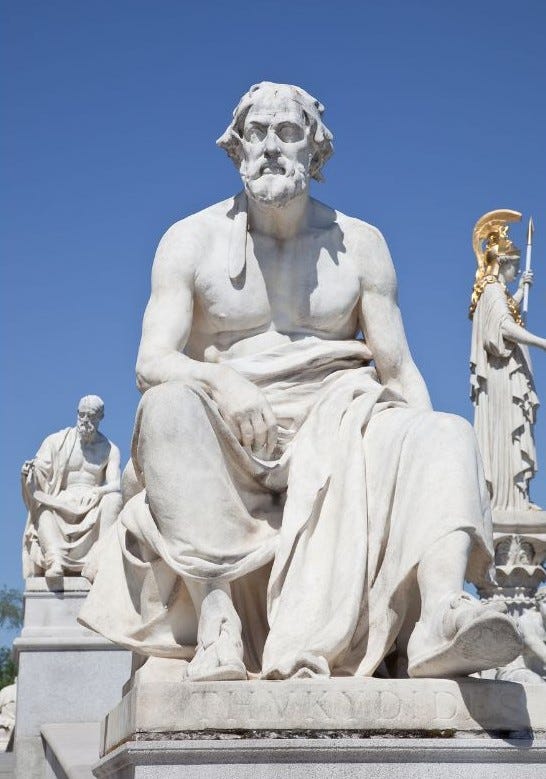
In a time of doubt about what constitutes a “great book,” Thucydides’ The Peloponnesian War surely qualifies. As we confront new uncertainty about the global balance of power, it is not only students who read Thucydides. His masterpiece lay at the center of Canadian Prime Minister Mark Carney’s speech at Davos in January, Chinese President Xi Jinping invoked the concept known as the “Thucydides Trap” when he met President Trump in May, and numerous opinion essays have turned to Thucydides for guidance. While continued relevance is one mark of a great book, to say The Peloponnesian War remains relevant after 2,500 years fails to capture the book’s full power. That power was evident this past Spring in my MIT class, “Humane Warfare.”
I teach great books in Concourse, a small program at MIT where first-year students take their core math and science classes along with a core humanities class and a weekly seminar about fundamental questions. In “Humane Warfare” this year, fourteen undergraduates from a range of majors undertook a semester-long, close study of Thucydides’ work. It was an extraordinary semester; attendance was almost perfect and engagement never flagged. Students would argue over the latest plot twist before I even arrived in the classroom. The book’s startling effect on them prompted me to try to clarify what makes a book “great” and why studying such a work is so rewarding for all students but perhaps especially for those at MIT.
MIT students excel at the clarity supplied by quantitative thinking. They are also innovative and imaginative, especially when it comes to building systems, developing algorithms, and solving material or physical problems. These qualities, however, do not exhaust what it means to live well. As human beings, citizens, and future leaders, MIT students must also confront critical questions that do not admit of quantitative solutions, and they must learn to distinguish better from worse actions when addressing such questions. Helping us do these things is the hallmark of a great book.
Thucydides makes justice a central question of his work: is Athens or Sparta to blame for the 34-year-long war? But rather than answer that question, he invites readers to think about it with care and nuance. This is precisely what occurred in my class. Students began as vigorous partisans of Sparta. One might have expected them to sympathize with democratic Athens, but, not surprisingly, they disapproved of Athens’ enthusiastic pursuit of empire and accorded the moral high ground to Sparta for her professed commitment to treaties and law. They quickly discovered, though, that there was more than first met their eyes, and unfolding developments challenged their initial moral judgments. As they plunged deeper into the details of the war, learned about myriad contributing factors, and observed the various parties under pressures occasioned by war, they were much less certain about each city’s merits and flaws.
Let me share a few of the complicating factors. First, despite Sparta’s claim to defend the freedom and independence of cities, she struggles to practice what she preaches. Precisely because she prefers peace and quiet, Sparta is slow to gear up for action. For all her efforts to observe treaties, Sparta puts her own domestic concerns above responsibility to her allies. Those domestic concerns even lead her, midway through the war, to exchange Athenian subject cities she has just liberated in return for peace with Athens.
At the same time, there was more to admire about Athens than first appeared. At home, she embraces an open cosmopolitanism, respect for private life, and vigorous political activity. While she resists her allies’ attempts to renege on the terms of their alliance, she welcomes them into Athens, even permitting them to sue her in her own courts. Students came to see the dynamism, ambition, and love of honor that lead Athens to empire also make her willing to offer quick and vigorous aid to current and potential allies alike.
Moreover, for all her ambition and imperial adventures, Athens’ unusual ability to reflect on her actions, which emerges especially in the stark contrast Thucydides presents between an Athenian and a Spartan trial impressed students. In Sparta’s trial of Plataea, a vanquished Athenian ally, legalism masks a ruthlessness towards enemies. Sparta makes the impossible demand that the Plataean prisoners prove they have never harmed Sparta. On finding them guilty, Sparta delivers them to their mortal enemy, Thebes. Thucydides invites a deeper examination of the trial by presenting it almost immediately after his account of Athens’ trial of Mytilene, a free and independent Athenian ally whose leaders betrayed Athens by attempting to join the Spartan alliance. Having initially voted to sentence the whole city to death, the Athenian people, troubled by the idea of punishing everyone for the leaders’ conduct, vote the next day to reconsider the judgment. In a decision urged on them by a sober speaker who insists Athens act on the basis of not anger but, rather, a calm and clear-sighted view of her true interests, they ultimately punish only the leaders of the rebellion.
Thucydides thus leads the reader to consider how cities address the inevitable tension between justice and interest. He tells us that Sparta’s main concern in the trial was pleasing her ally Thebes—she acted in her own interest. Thucydides does not blame her for this, but readers are struck by Sparta’s insistence on the pretense of justice, where justice is construed as what is in Sparta’s interest. By contrast, Athens, at least in this instance, reconciles an interest in preventing future rebellions with a just concern that only the guilty be punished. Whatever else may be said about Athens’ unruly political atmosphere, she can accommodate debate about the justice of a brutal sentence and even be willing to rescind it.
To be sure, as the war proceeds, Athens’ ambition overtakes her concern for justice and honor. Thucydides shows this in a private dialogue between Melian leaders and Athenian envoys that precedes Athens’ destruction of Melos. If students learned Athens’ concern with honor produces her noble willingness to defend her allies, they also saw how easily that concern degenerates into a narrow pursuit of self-interest.
Guided by Thucydides’ presentation of the war and through discussion of various episodes over the course of the work, students gained a nuanced understanding of both Sparta and Athens and learned neither had a monopoly on justice. Moreover, through his rich account of the various characters in the work for whom we alternately feel sympathy, admiration, frustration, hope, anger, and sadness, Thucydides prompted students’ reflection on what constitutes an admirable character and what it means to act well or badly in human affairs.
Students modified their doubts about Pericles, whose account of Athens plummets from soaring rhetoric to muted defense after a devastating plague, as they encountered the less strategic, more morally dubious leaders who followed him. They noted the contrast between Alcibiades’ astonishing hubris in domestic politics and his moderate policy in war. They discovered in Hermocrates a less destabilizing approach to stirring national ambition. They lamented how Brasidas’ unrelenting concern with honor ultimately overcame his noble intentions. They examined good leadership by comparing the divergent outcomes of the bold Demosthenes with the cautious Nicias. In short, they learned that human beings are both rife with failings and also capable of wise and admirable action.
This slow, careful study of one great work provided students with the perfect antidote to the onslaught of information to which they are subject and for which they have little context and even less basis for judgment. By delving into a book produced by an extraordinary mind, students began to develop that judgment—to navigate between justice and interest, to celebrate human achievement while being mindful of the excesses to which success can lead, and to recognize that no action is cost-free. Such insights are the basis not of relativism but of humane judgment, which, for MIT students in particular, must accompany the extraordinary power that as scientists and engineers will likely be in their hands. A book that sparks and steers deliberation about justice and greatness needed to become both good and wise—now that’s a great book!
 | A guest post by
|
It must have been a great course. Now I feel like reading Thucydides again. I read it freshman year of college, 1976, at Yale with Paul Rahe. Then, I think we students were mostly on Athens's side, because of its culture and its heroism against the Persians. Nowadays, it sounds like anti-imperialism and disdain for culture and heroism are dominant.